
Retail Shop Flooring Installation Checklist: The 2026 Business Guide
- Ross Bacon
- Jun 11
- 11 min read

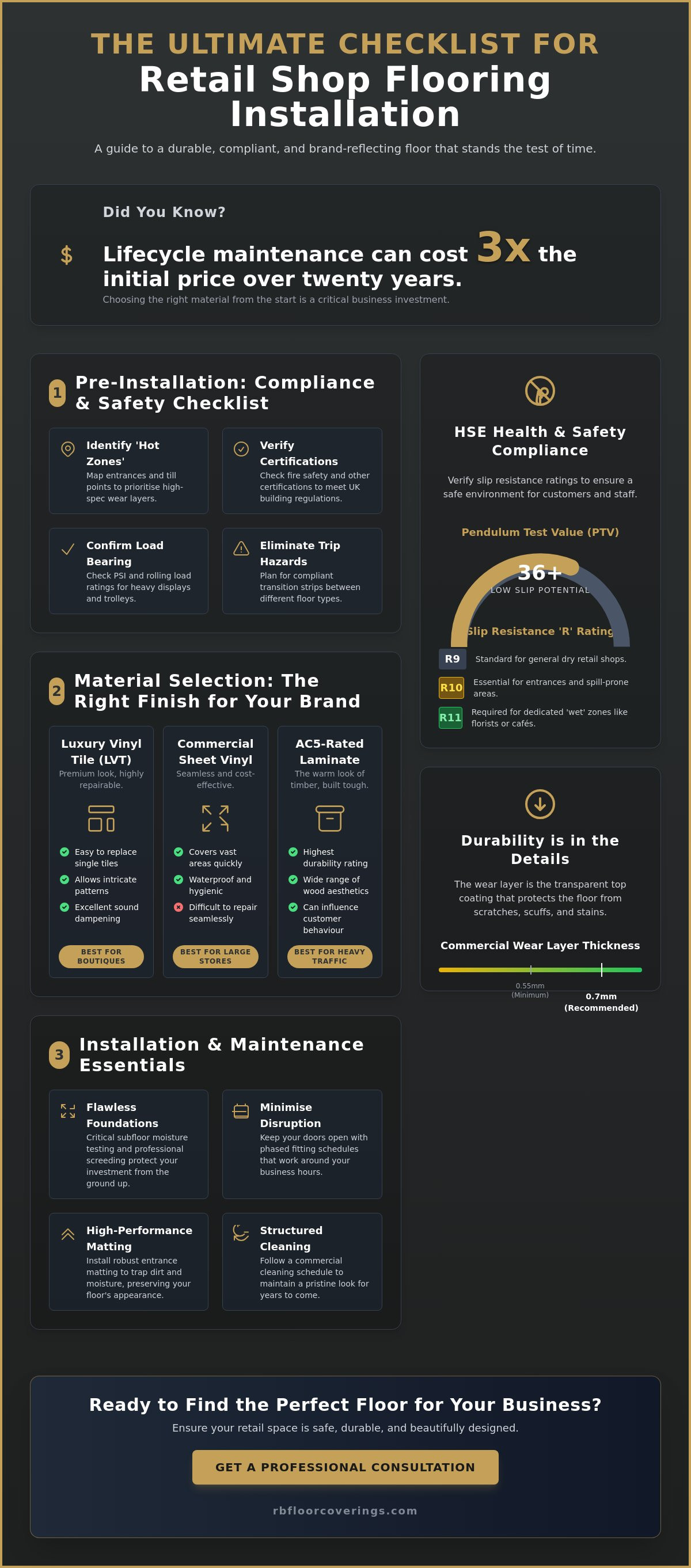
Did you know that whilst some materials offer low upfront costs, their lifecycle maintenance can end up costing three times the initial price over twenty years? It's a sobering thought for any business owner planning a retail shop flooring installation. You likely feel that choosing a new surface is a difficult balancing act between aesthetic appeal and long term survival. It's natural to worry about how much downtime your business will face or whether a premium look can truly withstand thousands of footsteps every single week.
We understand that you need a solution that is both practical and polished. This 2026 guide provides a comprehensive checklist to help you manage the process with confidence, ensuring your new floor meets UK safety standards without disrupting your daily operations. We'll walk you through essential subfloor checks, material selection for high traffic zones, and the logistics of a seamless fitting. By the end, you will have a clear roadmap to a durable, compliant floor that reflects the quality of your brand and stands the test of time.
Key Takeaways
Ensure your shop stays safe and compliant by identifying high-traffic 'hot zones' and choosing the correct slip-resistance ratings for your specific environment.
Select the perfect finish for your retail shop flooring installation by weighing up the premium look of commercial-grade LVT against the efficiency of sheet vinyl.
Protect your investment from the ground up by understanding the critical role of moisture testing and professional screeding in achieving a flawless, level surface.
Keep your doors open during the transition by learning how phased fitting and mobile showrooms can eliminate business disruption.
Maintain a pristine appearance for years to come with a structured commercial cleaning schedule and high-performance entrance matting.
Table of Contents
Pre-Installation Planning: The Compliance and Safety Checklist
A successful retail shop flooring installation starts with a thorough understanding of your environment. You don't want to discover six months down the line that your beautiful new floor is wearing thin at the entrance or failing to meet safety audits. We begin by identifying 'hot zones'. These are the areas around till points and doorways where footfall is concentrated. By mapping these zones, you can decide where to prioritise higher-spec wear layers or specific slip-resistant finishes before the work begins.
Don't overlook the importance of fire safety certifications. Commercial floor coverings must meet specific flame-spread and smoke-development standards to be compliant with UK building regulations. We always advise checking the manufacturer’s technical data sheets for these certifications before you commit to a purchase. Additionally, organising a professional site measurement is a step that saves both time and money. It's not just about square footage; it's about accounting for alcoves, door clearances, and subfloor transitions. Accurate measurements prevent the frustration of over-ordering or, worse, running out of material mid-job.
Identifying High-Traffic Requirements
Your floor needs to handle more than just footsteps. Heavy display units and shelving can exert significant pressure on specific points. You should check the PSI rating of your material to ensure it won't indent under static loads. If your team uses pallet jacks or heavy trolleys for restocking, the surface must be rated for rolling loads. Whilst Vinyl Composition Tile (VCT) was once the standard for these high-pressure environments, modern LVT offers a more premium look without sacrificing that essential durability.
Health and Safety Compliance
Meeting HSE workplace safety standards is non-negotiable. You need to verify slip resistance ratings, typically ranging from R9 to R11. An R9 rating is standard for dry shops, but R10 or R11 is essential for entrances where rain might be stepped in. We also look at the Pendulum Test Value (PTV); a score of 36 or higher indicates a low slip potential. If your shop has 'wet' zones like a florist or a coffee station, these areas need dedicated waterproof options. Planning for transition strips between rooms is also vital to eliminate trip hazards and ensure your retail shop flooring installation remains fully compliant.
Material Selection: Comparing Durable Retail Flooring Options
Selecting the right surface for your retail shop flooring installation isn't just a design choice. It's a strategic business decision. The material you choose dictates how often you'll need to maintain it and how your customers perceive your brand. Luxury Vinyl Tiles (LVT) have become the go-to for many boutique owners because they offer the look of natural wood or stone without the vulnerability. For larger department stores or back-of-house areas, commercial sheet vinyl provides a seamless, cost-effective alternative that covers vast distances quickly.
LVT vs. Commercial Vinyl
LVT offers a significant advantage in repairability. If a single tile is damaged by a dropped display unit, you can simply lift and replace that specific piece. With sheet vinyl, a deep tear often requires a patch that remains visible. LVT also allows for intricate patterns like herringbone, which can elevate a high-end retail space. When it comes to noise, the backing materials in these products are designed to dampen the sound of footsteps, preventing that hollow, echoing atmosphere that can drive customers away. Even for textile-based areas, following the CRI Commercial Carpet Installation Standards ensures that every part of your shop floor is fitted to professional benchmarks.
In boutique environments where you want the warmth of timber, AC5-rated laminate planks are a robust choice. This rating signifies the highest level of durability for laminate, making it suitable for shops with heavy daily traffic. The colour and texture of these planks also play a role in customer behaviour. Lighter, textured woods can make a small shop feel airy and welcoming, whilst dark, smooth finishes project a sense of luxury and exclusivity. If you need help choosing a style that matches your brand, explore our commercial flooring services for tailored advice.
Durability and Wear Layers
To ensure your floor survives years of footfall, you must look at the wear layer. For retail, a 0.55mm wear layer is the minimum, though a 0.7mm layer is far superior for high-traffic entrances. Many of these products feature an aluminium oxide coating, which acts as a shield against the scratches caused by grit and dirt. Commercial Use Class 33 or 34 is a classification that guarantees the flooring is specifically engineered for heavy commercial environments like busy shops and public buildings. This ensures your investment handles thousands of footsteps without showing premature signs of age.
The 'Invisible' Essentials: Subfloor Preparation Checklist
The visual appeal of your shop is what draws customers in, but the success of your retail shop flooring installation depends entirely on what lies beneath. We often see business owners tempted to lay new materials directly over existing floors to save time. This is a risky strategy that can lead to adhesive failure, uneven wear, and the voiding of commercial warranties. A professional installation begins with the complete removal of old coverings and a meticulous scrape-back of adhesive residue to ensure the new bonding agents can perform as intended.
Whether you have a timber or concrete base, assessing structural integrity is vital. Timber subfloors must be checked for rot or loose boards that cause creaking, whilst concrete bases need to be inspected for deep cracks or crumbling sections. Fixing these issues at the start prevents costly repairs once the shop is operational. It's the difference between a floor that lasts a decade and one that needs attention within months.
Moisture and Damp Proofing
Moisture is the silent enemy of LVT and vinyl. We always conduct a Relative Humidity (RH) test before any work starts. If levels are above 75%, a liquid Damp Proof Membrane (DPM) is essential for ground-floor retail units to block rising damp. It's often the most time-consuming part of the timeline because you simply cannot rush the drying process. Adhering to National Floor Safety Institute (NFSI) standards regarding surface conditions helps ensure that the finished floor remains stable and safe for public use.
Levelling and Screeding
To achieve retail perfection, we aim for an 'SR1' level surface. This is the highest standard of floor flatness, ensuring there are no dips or bumps that could cause "telegraphing", which is where subfloor imperfections show through the finished vinyl. For timber subfloors or areas with slight movement, we use fibre-reinforced screeds that offer flexibility without cracking. Understanding why floor screeding for LVT is essential is the key to a floor that looks premium and handles heavy traffic. This smooth foundation is what allows your chosen material to lay flat and look its best under bright shop lighting.
Installation Logistics: Minimising Business Disruption
Closing your doors for a retail shop flooring installation is a daunting prospect for any business owner. Every hour the shop is shut represents lost revenue, which is why we prioritise logistics that keep your trade moving. For larger units, we can often schedule a 'phased' installation. This involves working on one section of the shop floor whilst the other remains open to the public, allowing you to maintain customer flow throughout the project. It's a methodical approach that requires clear communication but pays dividends in saved trading hours.
If a phased approach isn't practical for your layout, we coordinate out-of-hours or weekend fitting to eliminate trading downtime entirely. This requires careful planning regarding the removal and replacement of heavy display units and shop fittings. We work with you to organise these moves, ensuring that everything is back in its correct place before your first customer arrives on Monday morning. By managing the heavy lifting and scheduling, we take the logistical burden off your shoulders.
The Timeline of a Shop Fit-Out
A typical fit-out begins long before the first tile is laid. One critical step often missed by less experienced teams is acclimatisation. Flooring materials need at least 24 to 48 hours in the actual shop environment to adjust to the temperature and humidity. This prevents the material from expanding or contracting after it's been glued down. Our Commercial Flooring Contractors Sheffield: Expert Supply and Fitting 2026 guide provides a detailed look at how we manage these timelines to ensure a perfect finish. From day one subfloor preparation to the final trim installation, every stage is timed to perfection.
The Mobile Showroom Advantage
The most efficient way to choose your new floor is by seeing it exactly where it will be installed. Our mobile showroom brings hundreds of samples directly to your door, allowing you to see colours under your specific shop lighting. This prevents the common mistake of choosing a shade that looks great in a brightly lit warehouse but clashes with your branding in-store. It also allows for immediate on-site expert measurement and advice, reducing the 'back and forth' that often delays a project. If you're ready to see how a new floor could transform your space, get in touch with our team to book a showroom visit.
Post-Installation: Maintenance and Longevity Checklist
Once the physical work of your retail shop flooring installation is finished, your attention must turn to protecting that investment. A new floor is only as good as the care it receives in its first few months. One of the most effective ways to prolong its life is by installing high-quality walk-off matting at every entrance. Statistics show that effective entrance matting can capture up to 80% of the grit and moisture that customers would otherwise track across your shop floor. This simple addition prevents the abrasive sandpaper effect that prematurely wears down even the toughest commercial wear layers.
You should also implement the use of heavy-duty felt pads on the base of all furniture and display units. Retail environments often involve moving shelving or seasonal displays; without protection, these movements can leave permanent scars on your floor. Establishing a clear cleaning schedule is equally vital to the success of your retail shop flooring installation. Daily sweeping and mopping remove surface debris, whilst weekly buffing helps maintain the original sheen. A quarterly deep clean by professionals ensures that ingrained dirt is removed before it can cause long-term damage.
Protecting Your Investment
Choosing the correct cleaning products is a detail that many shop owners overlook. You should always use pH-neutral cleaners specifically formulated for LVT and vinyl. Harsh chemicals can strip the protective coating, leaving the material dull and vulnerable to staining. Training your staff on immediate spill response is another essential step. If liquids are allowed to sit, they can seep into seams, potentially weakening the adhesive bond. For more detailed advice on long-term care, our guide on Commercial Flooring Contractors South Yorkshire: The 2026 Business Guide covers everything you need to know.
Why Choose RB Floor Coverings for Retail?
Selecting a Sheffield-based installer provides a layer of security that national contractors simply cannot match. As experienced commercial flooring contractors South Yorkshire specialists, we understand the local retail landscape. Whether you are based in Sheffield, Rotherham, or Worksop, we are close enough to provide rapid support if you need future repairs or advice. Our team brings a can-do attitude to every project, ensuring your shop is ready for customers exactly when promised. We take personal pride in every project, treating your business as if it were our own.
Take the Next Step Toward a Durable Retail Floor
A successful retail shop flooring installation is the result of careful planning, from verifying slip-resistance ratings to ensuring a perfectly level subfloor. By focusing on high-performance materials like commercial-grade LVT and adhering to a strict maintenance schedule, you protect your investment against the daily demands of heavy footfall. We've seen how the right preparation and logistical strategy can transform a shop without the need for costly downtime or trading interruptions. Your flooring should be a silent partner in your business's success, providing a safe and stylish foundation for every customer interaction.
As specialists in high-traffic commercial LVT and vinyl, our team has been providing expert local fitting since 2018. We make the selection process simple by bringing the samples directly to your shop, allowing you to see exactly how different finishes work under your own lighting. To start your project with confidence, book your free mobile showroom consultation in Sheffield, Rotherham, or Worksop today. We're here to ensure your new floor is as hardworking as your business.
Frequently Asked Questions
How long does a retail shop flooring installation typically take?
A typical retail shop flooring installation takes between 2 and 5 days, depending on the shop's square footage and the extent of subfloor preparation required. The first two days are often dedicated to essential tasks like moisture testing and floor screeding to ensure a perfect base. We plan every stage methodically to keep the project on track and ensure your floor is ready for customers as quickly as possible.
Can you install new retail flooring over existing tiles?
We generally advise against installing new materials over existing tiles for a retail shop flooring installation. To maintain commercial warranties and ensure longevity, the subfloor needs to be clean, level, and free of old adhesive residue. Laying over tiles can lead to "telegraphing", where grout lines show through the new surface, and increases the risk of adhesive failure over time.
What is the most durable flooring for a high-traffic retail shop?
Luxury Vinyl Tile (LVT) with a 0.7mm wear layer is the most durable choice for busy shops due to its scratch resistance and ease of repair. It handles thousands of footsteps daily whilst maintaining a premium appearance. For larger units where a seamless finish is preferred, commercial sheet vinyl also offers exceptional durability and is particularly effective in resisting moisture and grit tracked in from the street.
Do I need to close my shop during the flooring installation?
You don't necessarily need to close your business, as we can organise phased installations or out-of-hours fitting. By working in sections, we allow your shop to remain partially open, or we can fit the floor during weekends and nights to eliminate trading downtime entirely. We'll work with you to plan the logistics, including the movement of display units, to minimise any disruption.
What slip-resistance rating does my shop floor need to have?
Most retail shops require an R9 rating for dry areas, but R10 or R11 is essential for entrances where rain might be stepped in. To meet HSE workplace safety standards, we also look for a Pendulum Test Value (PTV) of 36 or higher in areas prone to moisture. Choosing the correct rating is vital for customer safety and ensures your business remains compliant with UK health and safety regulations.
Is LVT better than laminate for a retail environment?
LVT is usually the better choice for retail because it offers superior moisture resistance and is easier to repair than laminate. Whilst AC5-rated laminate is very tough, it can struggle with the dampness often found at shop entrances. LVT is also quieter underfoot and allows for individual tiles to be replaced if damage occurs, making it a more practical long-term investment for a professional shop.
How soon can customers walk on the new floor after installation?
Customers can often walk on the new floor immediately if we've used pressure-sensitive adhesives or click-fit systems. However, if a wet-set adhesive is required for heavy-duty vinyl, it's best to wait 24 hours before allowing full foot traffic or moving heavy display units back into place. We'll always provide you with a clear timeline based on the specific materials and adhesives used for your shop.
Do you provide flooring samples for shops in Sheffield and Rotherham?
Yes, our mobile showroom brings a comprehensive range of commercial samples directly to your shop in Sheffield, Rotherham, or Worksop. This service allows you to see how different colours and textures look under your specific shop lighting and alongside your branding. It's a convenient way to get expert on-site advice and accurate measurements without the need to visit a traditional showroom.


Comments