
The Importance of Underlay and Carpet Installation: A Complete 2026 Guide

Is that roll of padding at the bottom of your quote just a clever upsell, or is it actually the most important part of your new flooring? It's a question many homeowners in Sheffield and Rotherham ask, especially when trying to stay within a budget. You've spent weeks choosing the perfect earthy tone or natural wool texture, so it's completely understandable to feel hesitant about the costs associated with professional underlay and carpet installation. Nobody wants to waste money on unnecessary additions or worry that a poor fit might lead to frustrating ripples and fraying down the line.
In this guide, you'll discover why the invisible layer beneath your feet is the secret to a carpet that looks, feels, and lasts better for years. We'll demystify the technical side of the process, from understanding tog ratings for better insulation to ensuring your project meets the high benchmarks of British Standard BS 5325:2021. By the end, you'll know exactly how to achieve a durable, comfortable finish that transforms your house into a cosy home whilst protecting your investment for the long term. Whether you're refreshing a single bedroom or carpeting a whole house, getting the foundations right is the first step to a floor you'll love.
Key Takeaways
Understand why high-quality underlay acts as a vital shock absorber to prevent premature balding and unsightly "carpet stretch" over time.
Learn how to navigate different material types whilst using Tog ratings to maximise your home's thermal insulation and underfoot comfort.
Discover why professional underlay and carpet installation using specialist tools like power stretchers is more cost-effective than risky DIY attempts.
Get a clear overview of the professional fitting process, from essential subfloor inspections to the precise placement of gripper rods.
Find out how a local specialist with a mobile showroom helps you select the perfect colours and textures in the natural light of your own home.
Table of Contents
What is Carpet Underlay and Why is it Essential for Installation?
Think of your carpet underlay as the foundation of a house. Whilst the carpet provides the aesthetic finish, the underlay does all the heavy lifting behind the scenes. In the context of a professional underlay and carpet installation, this material serves as a vital shock-absorbing buffer that separates your new floor covering from the hard subfloor beneath. It's the silent partner that dictates exactly how your flooring will perform over the next decade.
It's about more than just a soft feel. Without this protective layer, the abrasive underside of the carpet would rub directly against the floorboards or concrete every time you walk across the room. This friction generates heat and physical wear that rapidly degrades the carpet backing. By absorbing the impact of every footstep, underlay prevents "carpet stretch", those unsightly ripples that appear when a carpet loses its structural integrity. It also stops premature balding, which occurs when the pile is crushed against a hard surface without any "give" to protect the fibres from snapping. The History of fitted carpets shows that as manufacturing techniques evolved, the need for a resilient base became clear to ensure the longevity of the weave.
The Science of Shock Absorption
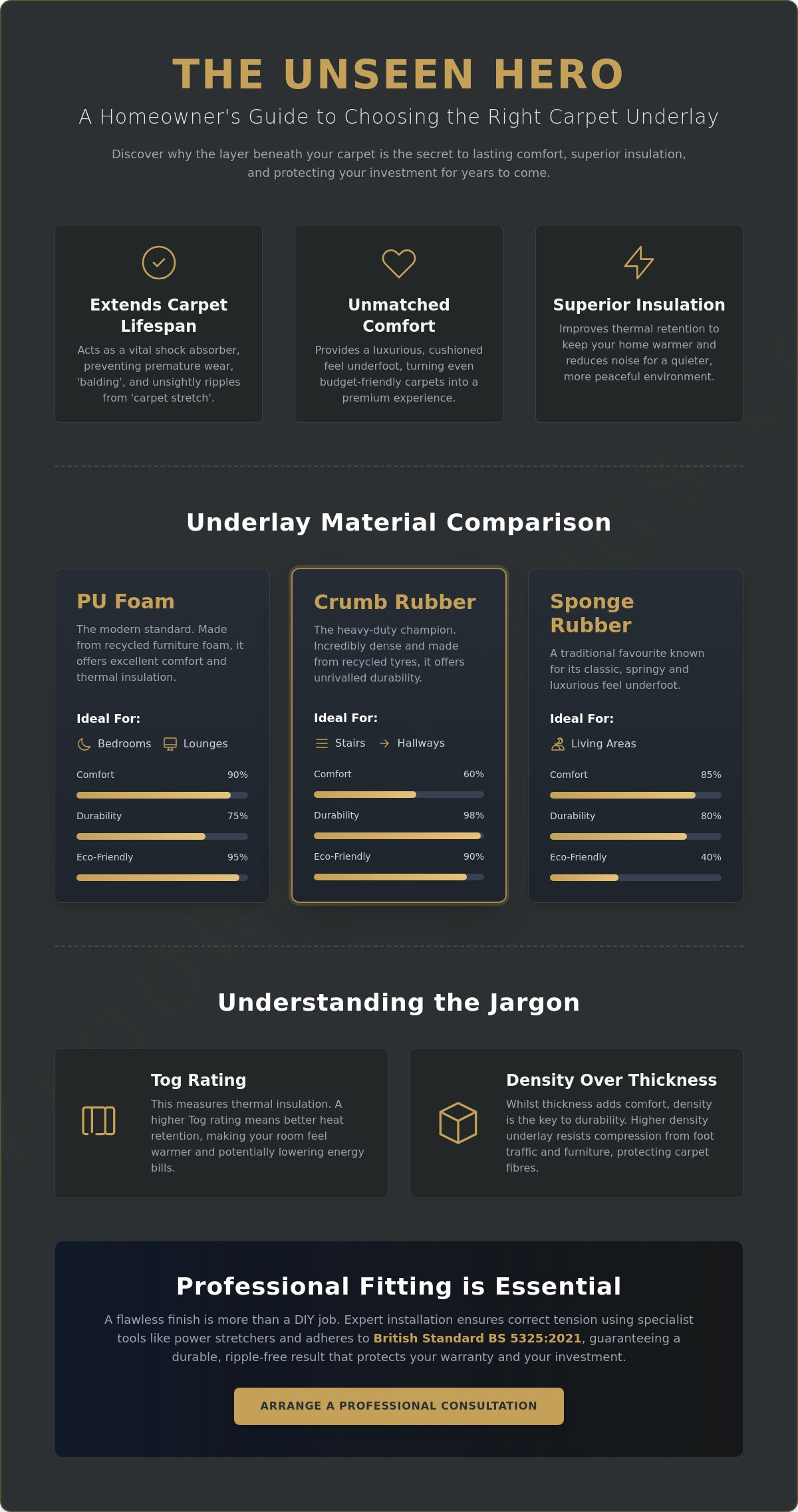
When you walk through a busy hallway, your weight exerts significant pressure on the carpet fibres. High-quality PU foam underlay is engineered with a "rebound" effect that allows the material to bounce back into shape instantly. This resilience protects the delicate pile from being flattened by heavy foot traffic. Higher density underlay offers greater resistance to compression, which directly enhances the long-term durability of the installation. By acting as a buffer, it creates a sense of luxury that makes even a budget-friendly carpet feel like a premium, high-end product.
Extending the Lifespan of Your Carpet
Investing in the right padding during your underlay and carpet installation is a classic case of prevention being better than a cure. A professional fitting ensures the carpet is held under the correct tension, whilst the underlay provides the necessary grip to keep everything in place. This lack of movement is what prevents the backing from grinding away over time. If you are looking for specific advice on more intimate spaces, our guide on bedroom carpet supply and fit explains how underlay choices differ in areas where barefoot comfort is the priority. Ultimately, choosing quality underlay now is significantly cheaper than replacing a worn-out carpet years before you should have to, especially when carpets are expected to last between 5 and 15 years.
Evaluating Performance: A Comparison of Carpet Underlay Types
Selecting the right materials for your underlay and carpet installation is about more than just finding the thickest padding available. In fact, a common mistake is assuming that thickness always equals quality. Each room in your home has different requirements, and the technical specifications of your underlay should match those needs to ensure your flooring performs as expected over its lifespan. Understanding the differences between PU foam, crumb rubber, and sponge rubber allows you to make an informed choice that balances comfort with practicality.
PU Foam vs. Rubber Underlay
PU foam has rapidly become the modern standard for domestic flooring projects. It's often manufactured from recycled furniture foam, which makes it a lightweight and comfortable choice for bedrooms and lounges. If you're prioritising environmentally preferable carpet choices, PU foam is an excellent option due to its high recycled content and excellent heat retention.
For areas that face constant punishment, crumb rubber is the heavy-duty champion. Made from recycled car tyres, this material is incredibly dense and resists compression better than almost any other type. It's the ideal partner for stairs and busy hallways where you want to prevent the carpet from "creeping" or wearing thin on the edges of the steps. Sponge rubber remains a traditional favourite for those seeking a classic, springy feel. It offers a luxurious bounce that's hard to replicate, though it's generally heavier and more challenging to handle during the fitting process.
Thermal Efficiency and Soundproofing
Many older properties in Sheffield and Rotherham suffer from draughts rising through original floorboards. This is where the Tog rating of your underlay becomes a critical factor. A high Tog rating, typically between 2.5 and 3.0, acts as an effective thermal blanket that traps heat within the room. This extra layer of insulation can contribute to lower energy bills by reducing the workload on your central heating. Conversely, if you have underfloor heating installed, you must choose a specialist low-Tog underlay to ensure heat can actually rise into the room rather than being blocked by the padding.
Acoustic performance is measured in decibels (dB), and it's a vital consideration for flat dwellers or busy family households. A high-quality underlay can reduce impact noise, such as footsteps or furniture being moved, by up to 40dB. This creates a much quieter, more peaceful environment, especially in multi-storey homes where sound travels easily between floors. Navigating these technical ratings can be confusing, which is why many homeowners prefer to speak with a local flooring specialist who can explain the specific benefits of each product in person.
Lounges: Opt for high-thickness PU foam for a plush, cosy feel.
Stairs and Hallways: Use dense crumb rubber to maintain the carpet's shape under heavy traffic.
Apartments: Prioritise high dB-rated rubber underlays to minimise noise complaints.
Rooms with Underfloor Heating: Ensure the combined Tog rating of carpet and underlay doesn't exceed 2.5.
Professional Fitting vs DIY: Why Expert Installation Saves Money
Attempting a DIY underlay and carpet installation might seem like a clever way to trim your renovation budget. However, the "free" labour of a weekend project often disappears when you factor in the cost of specialised equipment. Professional fitters don't just turn up with a craft knife; they use a suite of industrial tools including power stretchers to prevent future ripples, heat irons for seamless joins, and specialist snips for precision around door frames. Most homeowners find that by the time they've paid for tool hire and accounted for the inevitable wasted material from a miscut, the cost-benefit of doing it yourself has completely evaporated.
There's also the significant matter of your carpet's warranty. Many manufacturers specify that their products must be fitted according to the Carpet and Rug Institute's installation standards to remain valid. If you fit the carpet yourself and it develops a fault or wears prematurely due to incorrect tensioning, you'll likely find your warranty is void. A professional fitter provides a layer of insurance, ensuring that the tension and subfloor preparation are exactly as the manufacturer intended. This protects your investment and ensures that your underlay and carpet installation lasts for its full expected lifespan.
The Hidden Risks of DIY Fitting
One of the most common errors in amateur projects is the "knee kicker" mistake. Whilst a kicker is useful for positioning, it doesn't provide the uniform tension required for large rooms. Without a power stretcher, the carpet will eventually develop "waves" or ripples as it settles, which are both unsightly and a trip hazard. Tricky areas like landings and high-traffic corridors are particularly difficult to get right. This is why many homeowners choose hallway carpet fitting specialists who understand how to navigate multiple door thresholds and awkward corners without leaving visible seams or damaging your fresh paintwork and skirting boards.
The Value of a Professional Guarantee
Choosing an expert brings a level of speed and efficiency that's hard to match. What might take a DIYer three days of frustration can be completed by a seasoned professional in a few hours. This means less disruption to your daily life and a room that's ready to use almost immediately. Most importantly, you gain peace of mind with a fitting guarantee. If a seam needs attention or a gripper rod isn't holding, a reliable local specialist will return to fix it. For those looking for a stress-free experience, our carpet supply and fit Sheffield service offers a total solution that handles everything from the initial measurement to the final hoovering of your new floor.
The Step-by-Step Process of a Professional Carpet Installation
A successful underlay and carpet installation is a methodical journey that begins long before the first roll of fabric enters the room. Whilst many homeowners focus on the final look, the structural integrity of your floor is decided during the preparation phase. A professional installer follows a rigorous five-stage process to ensure the finish is tight, level, and free from the structural defects that plague amateur attempts.
Stage 1: Room Clearance and Inspection. The space is cleared of all furniture and the existing flooring is removed. The installer then conducts a thorough inspection of the subfloor to identify any damp, loose boards, or uneven patches.
Stage 2: Gripper Rods and Underlay. Gripper rods are secured around the perimeter of the room, leaving a precise gap for the carpet to be tucked into later. The underlay is then cut to fit perfectly within these rods and secured to the floor.
Stage 3: Positioning and Rough Cutting. The carpet is rolled out and positioned to ensure the pile direction is correct. A "rough cut" is performed, leaving approximately 5 to 10cm of excess material around the edges for final adjustments.
Stage 4: Stretching and Tucking. This is the most technical phase. Using specialised tools, the carpet is stretched across the room and hooked onto the gripper rods to create a drum-tight surface.
Stage 5: Final Trimming and Door Bars. The excess material is trimmed with precision, and the edges are tucked into the gullies. Finally, door bars are installed to create a seamless transition between rooms.
Subfloor Preparation: The Sheffield Context
In South Yorkshire, we often encounter a wide variety of housing styles that require different preparation techniques. Many Victorian terraces in Sheffield and older properties in Rotherham feature original floorboards that have bowed or gapped over the last century. In these cases, we may recommend ply-lining to create a stable, flat surface. Conversely, modern builds often feature concrete subfloors that might require a smoothing compound or "screeding" to remove imperfections. A meticulously cleaned subfloor is non-negotiable because any grit or debris trapped beneath the padding will cause irritating "crunching" sounds every time you walk across the room.
The Art of Stretching and Seaming
Achieving a professional finish requires more than just physical strength. A power stretcher is essential for ensuring uniform tension across larger rooms, as it provides a level of grip and pull that a simple knee kicker cannot match. When joins are necessary, professionals use heat-seaming tapes and irons to create nearly invisible seams that won't pull apart under foot traffic. It is also vital to ensure the pile direction remains consistent across the entire space; if pieces are fitted with the "grain" running in different directions, the light will reflect differently, making the floor look like two completely different colours. If you want to ensure your home benefits from this level of precision, book a professional floor measurement and consultation today.
Choosing the Right Specialist in South Yorkshire
Selecting the right partner for your project is just as important as the materials you pick out. In South Yorkshire, the sheer diversity of properties presents unique challenges for any underlay and carpet installation. Whether you are dealing with the high-ceilinged Victorian villas of Sheffield or the compact modern builds in Rotherham, a one-size-fits-all approach rarely works. You need a specialist who understands local housing styles and the specific structural quirks that come with them, ensuring your new flooring is both beautiful and functional.
The Mobile Showroom Advantage
Falling into the "shop light" trap is a common frustration for many homeowners. Retail showrooms typically use harsh, artificial fluorescent lighting that can drastically alter the appearance of a carpet sample. A soft sandstone beige might look perfect under a warehouse spotlight but appears completely different once it's in your lounge. By choosing a specialist with a mobile showroom, you bring the samples directly into your home. This allows you to see how the textures look against your existing furniture and how the colours shift amongst the natural light of your own rooms. It is a level of convenience that's particularly helpful for busy families or commercial clients who don't have the time to navigate busy retail parks.
Local Service, Professional Standards
RB Floor Coverings simplifies the entire journey by acting as a reliable, single point of contact for both supply and fitting. Our presence in Worksop and across South Yorkshire means we are never far away when you need expert advice. We take the stress out of the process by handling everything from the initial consultation to the final tucking of the carpet edges. Supporting an independent local specialist ensures you receive a personalised service whilst benefiting from the high standards you would expect from a seasoned professional.
Expert measurement is perhaps the most vital part of the planning phase. An amateur measurement often results in ordering far too much material, which leads to unnecessary costs, or too little, which creates awkward, visible joins. We focus on precision to ensure your underlay and carpet installation is as cost-effective as possible. By minimising waste, we protect your budget and ensure a seamless finish across every threshold. If you're ready to transform your space, booking a professional home consultation is the most dependable way to ensure your project is a success from the very first measurement.
Transform Your Floors with Confidence
Your flooring is a significant investment that deserves the best possible foundation. By now, you understand that high-quality underlay isn't just an optional extra but a vital component for thermal insulation, noise reduction, and the physical protection of your carpet's backing. Choosing a professional underlay and carpet installation ensures that every corner is precisely tucked and every seam is invisible, protecting your warranty and extending the lifespan of your floor for years to come.
We believe the process should be as simple and stress-free as possible. Our team brings years of local experience to homes across Sheffield, Rotherham, and Worksop, providing the expert fitting your project deserves. Instead of guessing under shop lights, you can view our wide range of samples in the natural light of your own rooms to ensure the perfect match for your decor.
Ready to get started? Book your free home measurement and mobile showroom visit today to see how we can bring your vision to life. We look forward to helping you create a space that feels just as good as it looks.
Frequently Asked Questions
Do I really need to replace my underlay every time I get a new carpet?
Yes, you should always replace the underlay when installing a new carpet. Over time, old underlay loses its resilience and becomes compressed, which means it can no longer provide the necessary support for the new pile. Reusing old materials often voids the manufacturer's warranty on your new carpet and can lead to uneven wear and premature balding in high-traffic areas of your home.
Can I use two layers of old underlay to make it feel thicker?
You should never double up on layers of underlay. This creates an unstable, overly spongy foundation that makes it impossible for the gripper rods to hold the carpet under the correct tension. This lack of stability leads to unsightly ripples and can cause the carpet backing to stretch or crack. It's much better to invest in a single, high-density product that provides the specific level of comfort you desire.
How long does a professional carpet and underlay installation take?
A standard-sized room typically takes between two and four hours for a complete underlay and carpet installation. If you're carpeting an entire house, we usually suggest allowing one to two days for the project to be finished. The exact duration depends on the amount of furniture that needs moving and whether your subfloor requires any extra preparation work, such as ply-lining or smoothing.
What is the best underlay for stairs and high-traffic hallways?
For stairs and busy hallways, a dense crumb rubber or a high-density PU foam is the most effective choice. These areas face constant punishment, especially on the "nose" of each step where the carpet is most vulnerable to crushing. A thinner but denser underlay provides the necessary support to keep the carpet in place and prevents the pile from flattening under the weight of constant foot traffic.
Should I choose PU foam or rubber underlay for my lounge?
PU foam is generally the most popular choice for lounges because it offers a plush, luxurious feel underfoot. It’s excellent for heat retention and creates a cosy atmosphere for living spaces where comfort is a priority. However, if your lounge is a through-room that sees a lot of activity, a sponge rubber alternative might be better for maintaining the carpet's resilience over a longer period.
Is underlay necessary if my carpet has a felt backing?
Whilst felt-back carpets are designed to be fitted directly to the floor, we still recommend using a separate underlay. A dedicated underlay provides significantly better comfort, soundproofing, and thermal insulation than a felt backing can offer on its own. It also helps to mask minor imperfections in your subfloor, ensuring a much smoother and more professional finish for your underlay and carpet installation.
How do I prepare my room before the carpet fitters arrive?
You should clear the room of all furniture, electronics, and fragile items before your fitters are due to arrive. Giving the subfloor a thorough hoovering is also helpful to remove any grit or debris that could cause irritating "crunching" sounds once the new floor is down. If you haven't arranged for a removal service, ensure the old carpet and underlay are fully disposed of so the workspace is clear.
Will new underlay help reduce my heating bills in an older house?
High-quality underlay can certainly help lower your energy costs, especially in older Sheffield or Rotherham properties with original floorboards. Choosing a product with a high Tog rating, such as 2.5 or above, creates an effective thermal blanket that traps heat within the room. This extra layer of insulation prevents draughts from rising through the floor and reduces the workload on your central heating system during the winter.


Comments