
Expert Stair Carpet Installation Specialists: A Guide to the Perfect Fit in 2026

Would you trust a general handyman to handle the most complex, high-traffic structural feature in your home? Whilst many believe any floor layer can tackle a flight of steps, the reality is that the intricate geometry of a winding staircase requires the precision of dedicated stair carpet installation specialists to ensure both safety and longevity. It's perfectly natural to worry about carpets coming loose or patterns looking wonky on those tricky turns, especially when your family's safety is at stake.
We understand that you want a staircase that feels as good as it looks without the stress of a poor fit. You deserve a home that feels secure and stylish, which is why choosing the right craftsman is just as important as picking the perfect colour. This guide will show you how specialist fitting prevents common hazards and which hard-wearing materials are currently leading the trends for 2026. We'll walk you through the essential benefits of high-density underlay, the latest durable pile options like wool-blends, and the methodical process of achieving a flawless, professional finish that stands the test of time.
Table of Contents
Why Stair Carpet Installation Specialists are Essential for Your Home
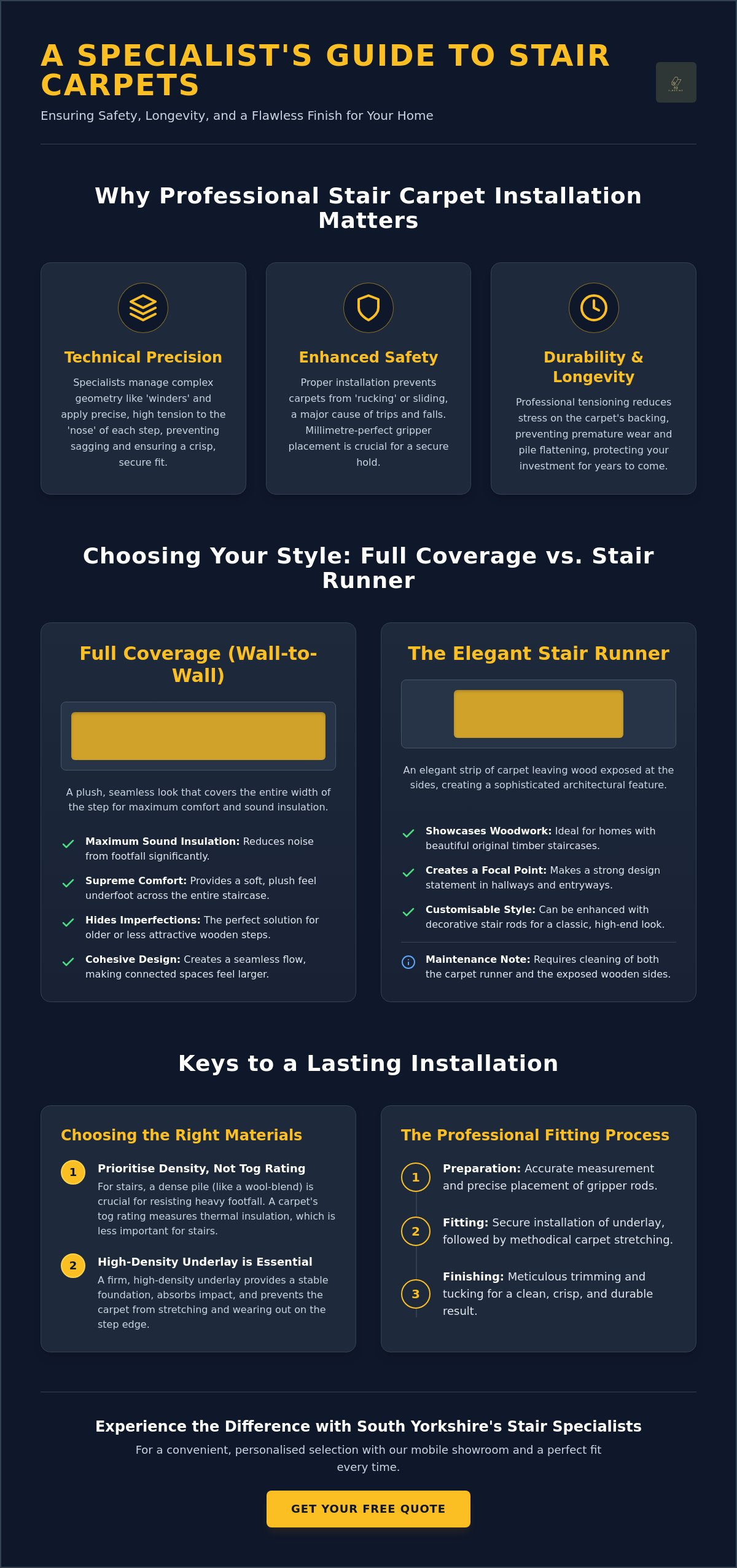
Stairs are arguably the most demanding area of any home to carpet correctly. Whilst a flat room allows for straightforward stretching, a staircase involves a series of independent high-tension points that must work in harmony. This is why stair carpet installation specialists are essential for a successful project. These experts specialise in the unique physics of the vertical-to-horizontal transition, ensuring that every riser and tread is wrapped with the exact amount of force required to prevent movement over time. Without this specific expertise, carpets often begin to sag within months, creating both an eyesore and a potential hazard.
The Technical Complexity of Staircases
The 'nose' of the step is the front edge where you place most of your weight. It is the most vulnerable part of any installation and requires maximum tension to stay crisp and secure. In Sheffield, many of our older terrace properties feature 'winders' or kite-shaped steps that turn at sharp angles. These aren't uniform rectangles, so they can't be fitted using standard bulk methods. A specialist must hand-cut and manipulate the material to ensure the pile runs in the correct direction for both safety and aesthetics. Looking back at the history of fitted carpets, it's clear that as materials have become more sophisticated, the skill required to install them on complex shapes has only increased. Standard room-fitting techniques simply don't translate to these three-dimensional challenges.
Safety and Longevity Benefits
Safety is the primary concern when carpeting stairs. If a carpet isn't anchored properly, it can 'ruck' or slide, which is a leading cause of household trips and falls. Our stair carpet installation specialists pay close attention to gripper rod placement. These must be positioned with millimetre precision to avoid the pins poking through the pile while still providing enough 'bite' to hold the tension. This level of detail directly impacts how long your flooring lasts. Professional tensioning reduces the stress on the carpet's backing, which prevents the pile from flattening or wearing thin in the centre of the steps. Investing in expert help also ensures the long-term performance of your underlay and carpet installation, as a secure fit prevents the underlay from shifting and breaking down prematurely. It's a practical choice that offers peace of mind and better value for money.
Understanding Stair Carpet Styles: Full Coverage vs. Stair Runners
Choosing the right style for your staircase is about more than just aesthetics; it's a decision that defines the character and acoustics of your entire home. Whilst some homeowners prefer the plush, encompassing feel of a full wrap, others opt for the architectural statement of a runner. Professional stair carpet installation specialists can help you weigh these options based on the condition of your treads and your household's specific needs. Each style offers distinct advantages in terms of maintenance, safety, and visual impact.
Full Coverage (Wall-to-Wall) Fitting
This method provides the highest level of sound insulation and comfort. It's particularly effective in busy family households where the constant thud of footsteps can echo through the house. By covering the entire width of the step, you create a seamless transition into a hallway carpet fitting project, which often makes narrow spaces feel larger and more cohesive. Full coverage is also the most practical solution if your wooden steps are older or have seen better days, as it hides imperfections and less attractive sub-floors completely.
The Elegance of Stair Runners
Runners are a favourite for period properties across South Yorkshire, allowing the beauty of original timber to show at the edges whilst providing a soft path down the centre. To ensure longevity, the edges of the runner must undergo 'whipping' or binding to prevent fraying over time. You can further elevate this look with decorative stair rods, which add a traditional, high-end finish to the installation. Runners are excellent for creating a focal point in entryways, though they do require the exposed wood to be kept clean alongside regular carpet maintenance.
Safety remains a top priority regardless of the style you choose. All high-quality materials should meet recognised safety criteria, including federal flammability standards, to ensure your home environment is protected. Narrow entryways often benefit from the vertical lines of a runner, which can make a cramped space feel more expansive. However, if your priority is a quiet, cosy home, a full wrap is often the superior choice. If you're struggling to decide, viewing our range of samples in the natural light of your own hallway can help clarify the best choice for your specific staircase.
Selecting the Best Materials for High-Traffic Staircases
Not every carpet is designed to withstand the relentless pressure of a busy staircase. Whilst a thick, plush pile might feel wonderful in a lounge, it can quickly become a safety hazard or lose its shape on a flight of steps. Expert stair carpet installation specialists always look for density over thickness. A high tog rating indicates excellent insulation, but on stairs, it's the density of the fibres that prevents the carpet from 'bottoming out' against the sub-floor. Choosing a material that adheres to professional installation standards ensures that your investment won't just look good on day one, but will remain resilient for years to come.
Wool vs. Synthetic: The Durability Debate
The industry favourite for longevity remains the 80/20 wool blend. This mix combines the natural resilience and fire-retardant properties of wool with the added strength of synthetic fibres. It resists crushing and maintains its 'bounce' far better than pure synthetic alternatives. However, modern high-grade polypropylene is an excellent choice for households with pets or young children, as these 'easy-clean' fibres are often bleach-cleanable and highly stain-resistant. You can test a carpet's density yourself by performing the 'grinning' test. Simply bend a sample of the carpet into a U-shape with the pile facing outwards; if you can easily see the backing through the fibres, it isn't dense enough for a staircase.
Pile Types and Performance
The structure of the carpet pile is just as important as the fibre itself. Short, dense twist piles are widely considered the best option for stairs because their tightly curled fibres hide footprints and vacuum tracks effectively. Conversely, deep shag piles or very long loops are a poor choice. They can be slippery underfoot and are prone to 'pilling' or pulling, especially on the nose of the step where the most friction occurs. When you are planning a wider home renovation, it's common to consider how your stairs will coordinate with a bedroom carpet supply and fit project. Matching the landing to the bedrooms whilst keeping the stairs in a more durable, shorter pile is a smart way to balance luxury with practicality.
Colour choice is the final piece of the puzzle. Whilst dark colours might seem like the obvious choice to hide dirt, they often show up every speck of lint or pet hair. Very light colours, on the other hand, will highlight high-traffic tracks almost immediately. Mid-tones, such as warm beiges, greys, or heathered blends, are the most forgiving. These shades mask the inevitable wear and tear of a busy South Yorkshire home, keeping your entrance looking fresh between deep cleans.
The Step-by-Step Professional Installation Process
Professional fitting is a methodical science that transforms a roll of textile into a structural safety feature. Whilst a standard room installation might take a couple of hours, a staircase requires a significantly more disciplined approach to ensure every centimetre is anchored correctly. Our stair carpet installation specialists follow a rigorous protocol that begins long before the first tack is driven into the wood. This process ensures that the finished result is not only beautiful but remains stable under the heavy footfall typical of a busy South Yorkshire home.
Preparation and Underlay Fitting
A flawless finish starts with a silent subfloor. Before the new material is laid, it's essential to remove all traces of old floor coverings and staples. This is the perfect time to identify and fix any loose floorboards or persistent squeaks that would otherwise be buried under new carpet. Once the treads are prepared, we install the underlay. Unlike room underlay, which prioritises thickness for a soft feel, stair underlay must be thinner but considerably denser. This high-density core prevents the carpet from sliding and protects the pile from being crushed against the hard edge of the step. Gripper rods are then fitted with precise spacing, usually about 10 to 15 millimetres from the riser, depending on the thickness of your chosen carpet.
Fitting Techniques: Waterfall vs. Cap and Band
The aesthetic of your staircase is largely determined by the fitting method used. The 'Waterfall' technique is a popular choice for modern homes; the carpet is brought over the nose of the step and falls straight down to the next tread without being tucked into the riser. This creates a clean, flowing look that works exceptionally well with patterned or striped designs. Conversely, the 'Cap and Band' method, often called the wrap method, provides a much more tailored finish. Here, the carpet is tightly wrapped around the nose and fastened securely to the riser, defining the shape of every individual step. This technique is often favoured for high-end installations or when dealing with a 'bullnose' step, the curved feature step at the bottom of the flight. Handling a bullnose requires a specialist's touch, involving intricate pleating and hand-stretching to ensure a smooth, wrinkle-free curve.
The final, and perhaps most critical, stage involves 'bolstering'. Using a heavy-bladed stair tool known as a bolster, the fitter drives the carpet deep into the 'crotch' of the stair where the tread meets the riser. This creates the high-tension fit that prevents the carpet from rucking or becoming loose over time. If you're ready to upgrade your home with a professional finish, book a specialist fitting appointment to ensure your stairs are handled with this level of technical precision.
Finding Expert Stair Carpet Fitting in Sheffield and South Yorkshire
Finding the right stair carpet installation specialists in South Yorkshire involves more than just searching for the lowest price. Local expertise is invaluable because it ensures that the person fitting your carpet understands the architectural quirks of homes in our region, from traditional Victorian terraces to modern semi-detached builds. Choosing a specialist based in Sheffield or Rotherham means you receive a more personalised level of aftercare, as we are always nearby should you need further advice or future maintenance. This community-focused approach builds a level of trust that large, national retailers often struggle to match.
The Mobile Showroom Advantage
One of the biggest challenges when choosing a new carpet is the deceptive nature of shop-floor lighting. Fluorescent tubes in a large warehouse can make a neutral tone look completely different once it's laid in a dimly lit hallway. By using our mobile carpet showroom Sheffield service, you can view hundreds of samples in the exact environment where they will be fitted. This allows you to match colours directly against your banisters, paintwork, and skirting boards, whilst avoiding the glare of artificial showroom lights. It's a convenient, time-saving approach that removes the guesswork and ensures the texture and shade you choose are perfect for your home's natural light.
Expert Local Service for South Yorkshire
Measuring a staircase is a precision task that leaves no room for error, particularly when dealing with the complex winders and landings common in local properties. A professional measurement accounts for the specific tension requirements and pile direction needed for safety, ensuring that enough material is ordered to cover every angle seamlessly. RB Floor Coverings provides a comprehensive professional carpet supply and fit in Sheffield, managing the entire project from the initial home visit to the final bolster. Whether you are in Rotherham, Worksop, or the heart of Sheffield, our team is ready to provide the technical skill and local reliability your home deserves. Booking a home consultation today is the first step towards a safer, more beautiful staircase that will stand the test of time.
Secure Your Home’s Future with a Professional Finish
Choosing the right flooring for your staircase is a decision that balances long-term safety with daily comfort. The technical demands of high-tension fitting and complex geometry mean that relying on stair carpet installation specialists is the only way to guarantee a result that won't slip or sag. By selecting dense, wool-rich materials and the correct fitting method for your specific architecture, you ensure your staircase remains a durable, attractive focal point for years to come.
At RB Floor Coverings, we take the stress out of the renovation process by bringing our expertise directly to your doorstep. Whether you need specialist fitting for domestic steps or large-scale commercial stairs, our team handles everything from expert measurement of tricky winding steps to the final bolstering. Book a free home consultation with RB Floor Coverings today to see our extensive range of samples in your own hallway through our convenient mobile showroom. We look forward to helping you achieve the perfect fit for your South Yorkshire home.
Frequently Asked Questions
How long does it take for specialists to install stair carpet?
A standard straight flight of thirteen steps typically takes between two and four hours for stair carpet installation specialists to complete. If your staircase features complex winders, a bullnose step, or requires a bespoke runner with decorative rods, the process can extend to a full working day. This timeframe includes the essential preparation work, such as removing old materials and the precise fitting of high-density underlay.
Can I use any carpet for my stairs, or do I need a specific type?
You should only use carpets specifically rated for 'Heavy Domestic' use, which corresponds to the EN 1307 Class 23 standard. Whilst a deep shag pile might feel luxurious in a bedroom, it represents a significant trip hazard on steps and will lose its shape almost immediately. A short, dense twist pile or a sturdy wool blend is much better suited to the concentrated pressure of stair traffic.
What is a stair runner, and how does it differ from a full-wrap carpet?
A stair runner is a tailored strip of carpet that covers the centre of the steps whilst leaving the wooden edges of the treads and risers exposed. This differs from a full-wrap or wall-to-wall installation, which covers the entire width of the staircase from stringer to stringer. Runners are often chosen for their architectural aesthetic in period homes, whereas full wraps offer maximum noise dampening and comfort.
Do I need to replace my underlay when getting new stair carpet fitted?
It's vital to replace your underlay every time you install a new stair carpet to ensure the longevity of your investment. Stair underlay endures far more vertical and horizontal friction than underlay in any other part of the home. Reusing old, flattened underlay will cause your new carpet to wear out prematurely and can lead to dangerous rucking or sliding on the treads.
How do specialists handle winding or curved staircases?
Professional stair carpet installation specialists handle winding staircases by individually templating and hand-cutting each kite-shaped winder. This methodical approach ensures that the pile direction remains consistent for safety and that any patterns flow seamlessly around the curve. This level of technical geometry is much more complex than a straight run and requires specific tools and experience to execute correctly.
Is it better to have a wool carpet or a synthetic one on the stairs?
An 80/20 wool-synthetic blend is widely considered the best choice for stairs because it combines the natural resilience of wool with the durability of man-made fibres. Wool has a natural 'bounce back' quality that resists crushing in high-traffic areas. However, if your household is prone to spills or has pets, a modern high-grade polypropylene synthetic may be preferable as it's often bleach-cleanable and highly stain-resistant.
What are stair rods, and are they necessary for a runner installation?
Stair rods are decorative metal bars that sit in the 'crotch' of the stair where the tread meets the riser. Whilst they provide a traditional and high-end finish to a runner installation, they aren't structurally necessary to hold the carpet in place. The runner is actually secured using heavy-duty gripper rods and staples; the rods are purely an aesthetic choice to enhance the hallway's design.
How do I maintain my stair carpet to prevent it from flattening in the centre?
To prevent flattening, you should vacuum your stairs at least twice a week using a vacuum cleaner with a motorised brush head to lift the pile. Concentrating on the centre of the steps helps to counteract the effects of regular footfall. Additionally, choosing a carpet with a high fibre density and a top-quality, high-density underlay from the outset is the most effective way to maintain the carpet's appearance over time.


Comments